Wearable technology for tracking sleep, physical activity, glucose levels, screen time, and other metrics has become more plentiful and sophisticated over the past decade, but clinical care has not kept pace in incorporating the proliferation of raw data streams. Matthew Buman, PhD, shared strategies for obesity care to better translate the deluge of information from wearables into knowledge and action.
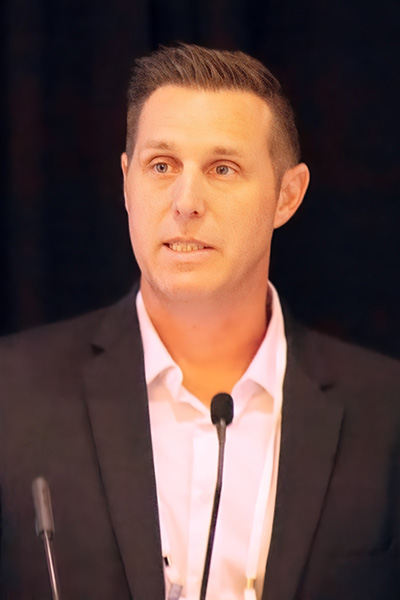
Matthew Buman, PhD
“Wearables can only become true engines of metabolic change when we shift from isolated metrics to closed-loop biobehavioral systems, and we need to ground that innovation in health equity, so that we can bridge the digital divide,” Dr. Buman said during his Nov. 16 Key Lecture, Beyond Counting Steps: Wearables as Engines of Metabolic Change.
A professor and director of precision health research initiatives at Arizona State University (ASU), as well as an associate dean of research for the ASU School of Technology and Public Health, Dr. Buman identified four obstacles to the clinical utility of wearable devices.
First, they rely on crude volume proxies, such as the common, but arbitrary target of achieving 10,000 steps per day, that ignore baseline metabolic risk.
Second, many devices rely on isolated behavioral framing, such as evaluating physical activity or sleep independently, despite new technology that allows evaluation of multiple metrics at the same time.
Third, the amount of data that wearables feed creates cognitive overload.
And fourth, many wearables lack real-time contextual awareness, as they report on what has happened rather than trying to intervene and predict what will happen going forward.
“The promise of modern wearables lies in closing the loop between the data that comes in and the action that comes out,” Dr. Buman said.
He then identified areas of opportunity for that advancement.
The first is to extend the reach of the clinic by uniting passive accelerometry already incorporated into many smartphones and wearables with continuous glucose monitoring, heart rate variability, skin temperature, and other real-world physiology.
Another is a better understanding of the full 24-hour holistic continuum.
“We can now analyze codependent daily time balances across sleep, sedentary behavior, and physical activity to look at the synergistic metabolic effects of all of these behaviors,” Dr. Buman said. “We couldn’t do this before because we would have single devices that could only measure one of these things. Now we can fully and relatively reliably measure the entire 24 hours, and we can start to look at the codependence across these behaviors.”
The promise of modern wearables lies in closing the loop between the data that comes in and the action that comes out.
— Matthew Buman, PhD
A third area of opportunity is the ability to translate a mix of incoming raw data into validated, clinically interpretable endpoints, or fit-for-purpose digitally derived measures.
“Probably the most exciting is this idea of closing the loop, feeding these digitally derived measures into just-in-time and other types of adaptive interventions that support dynamic intervention at the time that the risk peaks,” Dr. Buman said.
He also addressed emerging structural and policy drivers of metabolic health and how academia and industry can work together.
“Even our most sophisticated biobehavioral algorithms will fail to improve population health if our academic and our industry ecosystems stay siloed, and if we can’t address financial barriers that are locking high-risk patients out,” Dr. Buman said.
On the academic side, he sees opportunities to provide more independent evaluation, test new wearable models for equity across populations to avoid deepening existing digital divides and develop specific research application programming interfaces that would let researchers test models within existing commercial platforms with larger cohorts than are typically seen in academia.
“We’re developing apps that are not scalable. They’re highly customized,” Dr. Buman noted. “If we can bring these two things together, where we can test and validate within these large industry ecosystems, we can move the science much more rapidly.”
Another component of the digital divide is socioeconomic status (SES).
“We have a challenge in that lower SES groups carry the highest burden of cardiometabolic disease and obesity, yet hold the least access to advanced digital tools,” Dr. Buman noted.
Even though digital tools have become more democratized as the initial cost of purchasing a smartphone or wearable has decreased, many of the most beneficial features of wearable devices, such as AI coaching or integration with another device, require an ongoing, paid subscription.
Dr. Buman gave an overview of a pilot program recently released by the Centers for Medicare & Medicaid Services aimed at improving access to care. Advancing Chronic Care with Effective, Scalable Solutions (ACCESS) Model provides eligible Medicare beneficiaries with zero-cost wearables, consumables, coaching platforms, and electronic health record integration.
Overall, there is cause for optimism regarding wearable technology, but more work is needed to optimize its use in clinical care.
“The key takeaway is that realizing wearables as an engine for metabolic health requires using continuous biobehavioral monitoring, closing the loop in a way that allows us to promote equitable policy and also cross-sectoral partnerships,” Dr. Buman concluded.
Save the Date for ObesityWeek 2027
Reserve Nov. 7–10, 2027, on your calendar for the live conference sessions of TOS 45th Annual Scientific Meeting at ObesityWeek 2027.
More details will be posted as they become available.