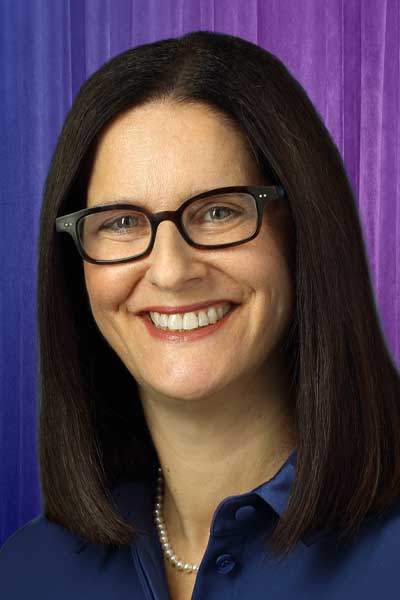
Delivering a Key Lecture on Nov. 17, the lead investigator of the landmark ACHIEVE study, Gail Daumit, MD, MHS, will share insights into her years of work examining effective approaches to reducing cardiovascular risk factors in individuals living with serious mental illness. Her presentation, Translating and Disseminating a Behavioral Obesity Treatment Intervention for Adults with Serious Mental Illness, will also touch on her latest studies in multiple community mental health settings and how the principles guiding this research can translate to other areas of obesity care and improving cardiovascular health.
Gail Daumit, MD, MHS
With its results published in 2013, the ACHIEVE trial demonstrated that adults living with serious mental illness could make healthy lifestyle choices and lose weight through a behavioral lifestyle intervention tailored for individual needs delivered in community-based programs. Dr. Daumit recalled that the publication of the ACHIEVE results led to numerous requests for curriculum and leader’s manuals from community mental health programs across the nation. Over the years, she and her colleagues have worked to provide program materials by conducting implementation research and creating a modified curriculum that incorporates input from study partners and pilot studies at several community mental health programs.
“We had this proven, evidence-based practice in achieving a healthier lifestyle, but we wanted to understand how we could best scale it so it could be used beyond the programs where our research staff had delivered it. In order for widespread uptake, we need to train and empower community mental health program staff to deliver ACHIEVE,” said Dr. Daumit, a professor of medicine at Johns Hopkins University School of Medicine. “So, the ACHIEVE trial continues.”
In her Key Lecture, Dr. Daumit will share some of the goals and challenges of her latest work. Partnering with psychiatric rehabilitation programs and other community-based mental health programs, Dr. Daumit and her colleagues will provide all programs with basic implementation support through training and technical assistance. Some partners will receive more intensive support, including facilitation and participation in learning communities, where representatives from the different sites can share best practices and lessons learned during the trial.
“We are looking at how best to deliver a proven program,” Dr. Daumit explained. “Our hypothesis is that if you receive a more intense strategy, then you will be more likely to deliver it. One of the interesting things that especially excites us about this trial is that we are not just lifting the curriculum that we developed last time. We are working with community organizations, state policy makers, Medicaid programs, etc. to adapt the program in parallel with the trial. In this way, when the trial ends, we will have a program that can start being adopted and applied for billing, for accreditation, and for other mechanisms that make it a sustainable initiative.”
Part of what we do in working with partners and people living with serious mental illness is to help them prioritize the most important risk factors and then work on those in a person-centered way.
— Gail Daumit, MD, MHS
As the focus of Dr. Daumit’s research has moved from the individual randomization approach of ACHIEVE to the cluster randomization approach of her latest studies, it has also incorporated new realities in the field of obesity care. Obesity medicine specialist and clinical researcher Ariana Chao, PhD, CRNP, is providing the latest insights on tailoring a nutrition program for individuals using GLP-1 therapies.
The new strategies have also drawn heavily on patient response and the contributions of peer leaders who helped design interventions that make participation easier for people with mental health challenges.
Dr. Daumit said she will also talk about a key theme running through her research—the challenge of multimorbidity in achieving personal health goals.
“Part of what we do in working with partners and people living with serious mental illness is to help them prioritize the most important risk factors and then work on those in a person-centered way. We see this holistic approach as something that is very needed in real-world practice,” Dr. Daumit said. “These principles are applicable to other groups such as older adults or adults with physical or mental health challenges who might not have access to GLP-1s or to weight-loss support. But the general approach is translatable to any group—adjust the type of support to the needs of a particular group and to that group’s ability to engage in the program.”
Dr. Daumit’s Key Lecture takes place Tuesday, Nov. 17, 10–11 am ET, at Potomac D456, Ballroom Level, in the Gaylord National Resort & Convention Center.
Other ObesityWeek 2026 Key Lectures on Tuesday include (all times are listed in ET, and all room locations are in the Gaylord National Resort & Convention Center):