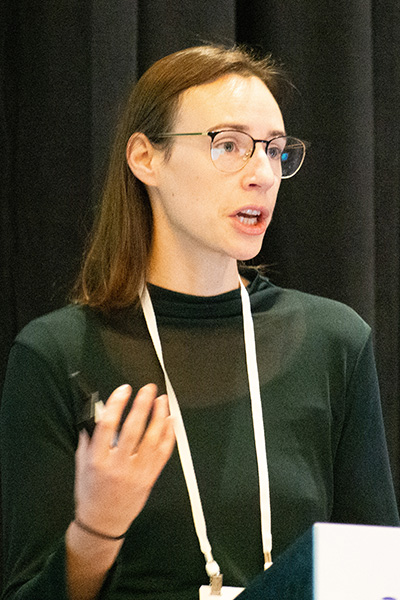
The relationship between the immune system and adipose tissue has been well documented since the 1960s and has given rise to the field of immunometabolism. Investigators continue to examine the reasons behind the infiltration of immune cells that surround adipocytes in obese adipose tissue and the accumulation of mast cells as the number of fat cells increases. This research is also leading to possible insights for clinical applications to improve the care of those living with obesity.
Evanna Mills, PhD
“We’re starting to see some of this biology translate into the clinic, and there are efforts now to target immune-mediated inflammation in many diseases associated with obesity,” said Evanna Mills, PhD, in her Nov. 15 Key Lecture, The Immune System and Regulation of Adipose Tissue. “This is a very complex interplay. Depending on the type of adipose tissue, be it brown, beige, or white fat, depending on the nutritional state, obese or not, or whether they’re exposed to things like cold, you see a profound distinction in the immune landscape of these adipose depots.”
Dr. Mills, an assistant professor in immunology at the Dana-Farber Cancer Institute and Harvard Medical School, provided background on how the immune and adipose systems communicate and shared her research on metabolite regulation and macrophages in those with and without obesity.
“This landscape (of adipose depots) changes dramatically with obesity,” she explained. “These macrophages become inflammatory, and they produce mediators, predominantly cytokines, that can alter the function of adipocytes. You also have an increase in cytotoxic and inflammatory T cells, as well as NK [natural killer] cells and dendritic cells, and this overall supports this inflammatory milieu within the obese adipose tissue, which we know is pathological.”
Dr. Mills’ research has predominantly focused on two structurally similar metabolites, succinate and itaconate, and trying to understand how they signal in the context of adipose tissue and in macrophage-mediated biology.
“We think that if we can understand what these signals are between changes in metabolism and the downstream consequences, that this is a potential opportunity for novel biology,” Dr. Mills said, explaining that targeting downstream signaling, for example, cytokine signaling, hasn’t been effective, prompting investigators to consider upstream targets.
There’s been a reinvigoration in the field of harnessing brown fat to treat disease, and I think this is something that really needs to be considered as a metabolic benefit associated with targeting thermogenesis.
— Evanna Mills, PhD
Research indicates brown fat has unique capacities to improve metabolic health beyond its ability to activate thermogenesis and burn calories.
“We actually think it’s really important for systemic metabolic health and controlling inflammation,” Dr. Mills explained. “There’s been a reinvigoration in the field of harnessing brown fat to treat disease, and I think this is something that really needs to be considered as a metabolic benefit associated with targeting thermogenesis.”
However, she noted that strategies to activate brown adipose tissue by directly stimulating these cells, while effective, are not viable clinically.
“We need to think about creative ways to turn on brown adipose tissue,” she said. “We think that exploiting cells that control adipocytes might be one way.”
By targeting mitochondria, Dr. Mills and colleagues think they will be able to break through the current efficacy ceiling of targeting cytokines. Using an uncoupling protein 1/succinate receptor 1 double-knockout mouse model, Dr. Mills’ team showed that when this receptor is knocked out in the context of UCP1 ablation, overall systemic metabolic health improves.
“All of the molecular defects we observed with our proteomic studies, with our PCOR (patient-centered outcomes research) analysis, with our flow cytometry, were rescued by succinate receptor 1 ablation,” Dr. Mills said. “This, overall, is telling us that there is a really important role for brown adipose tissue that has been ignored for a very long time. That’s nothing to do with its ability to decrease adiposity. It can sequester pro-inflammatory metabolites and, therefore, control systemic inflammation and pathology.”
Metabolites act as signaling molecules by binding to proteins, including cell surface receptors, transporters and intracellular proteins, she explained. These interactions can drive changes in protein-protein interactions, protein stability, protein structure and function.
“It’s ultimately through these interactions with proteins that macrophage function becomes perturbed, and this then can drive disease,” Dr. Mills said. “So, our question is: If we can identify what these protein targets of the metabolites are, maybe this is an effective way to target this therapeutic? We can’t drug a metabolite, but we can certainly drug proteins.”
Continued research in this field may yield new ways to manage obesity and improve patient outcomes.
ObesityWeek 2026 Goes Hybrid
Recognizing many conference registrants were affected by flight interruptions across the United States, ObesityWeek 2026 has transitioned to a hybrid meeting format, allowing participants to stay connected and access scientific content.
Registered attendees can view sessions live through the conference app or by using the desktop link below (go to the session listings and click the Watch Live button for a chosen session). Live sessions are available during their scheduled program times; replay recordings will be available as part of ObesityWeek OnDemand beginning late January 2027. Purchase ObesityWeek OnDemand through conference registration by Nov. 17.